
This is an interesting half-day tour because it strings together three Absheron Peninsula stops that all connect to fire, faith, and ancient life, all with a private guide. I like the front-door hotel pickup and the comfort of a private chauffeured vehicle that gets you out of the city without stress. One drawback to keep in mind is the pace, it is a compact 4 hours, so you should be ready for short walks and quick transitions.
I also like how the guide explains the real-world twist behind the legend, at Ateshgah you see a temple built by different communities, and at Yanardag you watch natural gas flames that have burned for a very long time. The main thing to plan for is timing, because the tour is in the morning, while Yanardag is often most dramatic near evening.
Key highlights you should know before you go
- VIP feel with a private vehicle: hotel pickup and drop-off plus door-to-door transport
- Ateshgah Fire Temple’s multi-faith story: reverence tied to Zoroastrians, Hindus, and Sikhs
- Gala Archaeological and Ethnographic Complex in one visit: burial mounds, tombs, houses, water storages, plus mosques and baths
- Yanardag’s natural gas flames: visible on the slope of a hill about 25 km from Baku
- Simple ticket math: Ateshgah and Gala have admission fees, while Yanardag is free
- Guides who explain clearly: AzTerra Travel has led trips with guides such as Farman, Karim, and Kirim, often with calm, efficient driving like Jafar
Why Ateshgah and Yanardag belong on the same day
If you want a Baku outing that feels different from the usual city highlights, this tour hits the Absheron Peninsula’s older pulse. You start with Ateshgah, a fire-temple complex linked to how different faiths interpreted natural flames. Then you go to Gala (Qala) Museum Complex, where the story shifts from sacred fire to the people who lived on the land for thousands of years.
Finally, you end with Yanardag, the famous burning hill. The fun part is how the guide ties it all together for you: fire worship as a concept, fire as a natural phenomenon, and fire as a reason humans built places and rituals around what they saw.
The biggest value here is not just seeing three sites. It is understanding why these places are connected in the minds of the communities that used them, even when those communities were different.
More trips to the burning mountain:
- Baku: Gobustan, Volcanoes, Fire Temple and Yanardag Day Trip
★ 4.7 · 433 reviews - Gobustan & Mud, Fire Temple, Burning Mountain (Group & Private)
★ 4.5 · 418 reviews - Gobustan, Mud volcanoes, Fire temple, Fire mountain PRIVATE TOUR
★ 5.0 · 47 reviews
Price and value: is $95 per person a fair deal
At $95 per person for about 4 hours, the pricing makes sense when you compare it to what you would spend in both time and effort on your own. This is not a bus tour. You get private transport, a professional guide, and fuel surcharge included.
The part to budget carefully is entrance fees. Ateshgah and the Gala Museum Complex both list admission tickets as not included. Yanardag is free, so at least one stop is easy on your wallet.
If you like structure, this tour is built for you. The route is tight, and the stops are timed in a way that lets you get real commentary instead of rushing blindly through three separate locations. If you prefer long, unhurried museum time, you might feel the schedule is a bit quick, but the trade-off is you see more in half a day.
Morning logistics that actually matter in Baku
Start time is 9:30 am, and the tour includes hotel pickup and drop-off. That is a big deal in Baku, because Absheron outings can eat your day if you have to coordinate taxis and waiting times. Here, you get the convenience of a driver meeting you and taking you door to door.
You also get a mobile ticket, which helps reduce last-minute hassle. The tour is private, so only your group participates. That usually means fewer interruptions and more room for questions, especially for the kind of history this route covers.
One practical note: bring a little patience for the natural fire stops. Yanardag can be crowded with people wanting the best views, and the site is built around watching flames. Even if your time there is only about 30 minutes, your experience will feel smoother if you dress for standing outside and keep your belongings secure.
Stop 1, Ateshgah Fire Temple: fire, faith, and a pentagonal courtyard
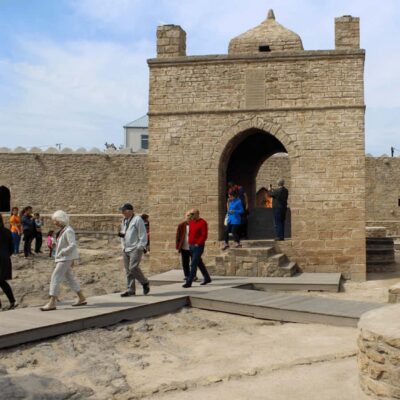
You start at Ateshgah, the Fire Temple on the Absheron Peninsula near the outskirts of Surakhani village, about 30 km from central Baku. This site is famous because it sits on a natural gas phenomenon. Underground gas reaches the surface, contacts oxygen, and lights up. Human faith systems then attach meaning to what is happening.
The temple as it looks today dates to the 17th to 18th centuries. It was built by a Baku-based Hindu community that was related to Sikhs, which is a detail I love because it immediately complicates the simple idea of a single religion owning the story. In different periods, the territory was revered by Zoroastrians, Hindus, and Sikhs.
The complex has a pentagonal layout with an open courtyard. At the center is the temple-altar area, and the space was used as a place of pilgrimage. What you want to notice during your visit is the blend of architecture and belief. Even if you are not religious, it is a powerful example of how people in one place can interpret the same natural event in different ways.
Time on site is about 40 minutes, and admission tickets are not included, so keep that in mind for your budget.
Other visits to the Ateshgah fire temple:
- Gobustan-Mud Volcan-Fire Temple and Mountain Tour/Entrance inc
★ 5.0 · 267 reviews - Gobustan & Mud, Fire Temple, Burning Mountain, H.A. Center
★ 4.6 · 46 reviews - Ateshgah Fire temple and Burning mountain tour
★ 4.5 · 42 reviews - Baku: Gobustan, Mud Volcanoes, Fire Temple, & Yanar Dag Tour
★ 4.8 · 36 reviews
Stop 2, Gala Archaeological and Ethnographic Museum Complex: the long human story of Absheron
Next you head to the Qala Archaeological and Ethnographic Museum Complex, also called the Gala complex. This stop is about showing you how Absheron has been used again and again. It is not a single-era site. The range runs from the third millennium BC to the twentieth century.
Expect a guided visit where you can see a lot of different categories of remains in one place. The grounds include burial mounds and tombs, plus houses and water storages. You will also find ruins of an ancient castle, and the site features religious and civic structures such as five mosques and three baths.
I like this stop because it shifts you from legends of fire to the practical reality of daily life. In a few steps you go from how people buried the dead to how they stored water, built homes, prayed, and cleaned up. The guided explanation helps you connect those dots instead of just taking photos of scattered ruins.
Time on site is again about 40 minutes, and admission tickets are also not included. The drawback is simple: if your priority is only big, dramatic monuments, this can feel more like a focused walking tour through history. If you enjoy context, this is one of the strongest stops on the route.
Stop 3, Yanar Dag: watching natural flames in a protected area
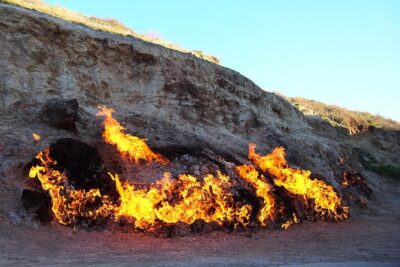
Your final stop is Yanar Dag (also written Yanardag). It is located about 25 km north of Baku. The attraction is a hill where natural gas burns on its slope. The flames are described as having tongues that can be up to about a meter long, and they lick an area roughly 10 meters wide.
A key detail you will hear, and you should take seriously, is that the fire can sear if you get too close. The site is set up for watching, and you will see people using benches to observe the blaze.
Timing matters here. The most effective viewing is said to be in the evening, when the contrast makes the flame look stronger. Because this tour is scheduled for the morning, you might not get the same show as the late day visitors. Still, you should be able to see the flame activity, and the guide explanation will help you understand what you are looking at.
Yanar Dag is listed as free to enter, and it has been protected as a state conservation area since 2007. Time at the site is about 30 minutes, so plan to use that time for observation and photos, not deep wandering.
Your guide and the calm factor, what I’d bet on
This tour is built around a professional guide and a private vehicle, which is exactly where you want help on a history-heavy route. The guide is the difference between watching fire and understanding what it meant to people who lived here long before you arrived.
AzTerra Travel has guided trips with names that come up often, including Farman, Karim, and Kirim. Drivers also get praise, including Jafar, and that matters because these roads and stops work best when the timing is steady. I would expect clear communication, a calm pace, and enough explanation that you feel oriented by the time you reach each site.
If you are the kind of traveler who likes to ask questions, this private setup helps. You can push for details about why Ateshgah connects to multiple communities, or why Qala spans so many centuries.
How to make the most of the 4 hours
You are going to move fairly quickly between stops, so your best strategy is to travel light and stay ready. Entrance tickets are not included for Ateshgah and Gala, and food and drinks are not included for the whole tour. I recommend you treat the day like a mission: small plan for water, and time to buy something after the tour if you want.
Here are a few practical tips that will improve your experience:
- Wear shoes you trust, you will be walking around temple and museum grounds.
- Plan your camera settings for low-light contrast anyway. Even in daylight, the fire can look better if you experiment.
- At Yanar Dag, keep a safe distance and treat benches as part of the experience, not optional extras.
- Ask your guide to connect the dots between the natural gas flames and the faith traditions. That is the tour’s main payoff.
If you are sensitive to heat, standing near a burning slope is not the time to linger without thinking. The site is designed for viewing, so follow the safe boundaries and let the guide set the pace.
Who this tour suits best, and who might want to skip it
This tour suits you if you want a focused Absheron Peninsula day without the hassle of arranging separate rides. It is also ideal if you like history that has real-world roots, not just stone-and-stories sightseeing.
You will likely enjoy it most if you:
- Want three key sites in one morning
- Like guided context on multi-faith heritage and long timelines
- Prefer private comfort over bus logistics
You might hesitate if you need a relaxed schedule, because each stop is timed and you are only there about 30 to 40 minutes at a time. Also, if your only goal is the most dramatic Yanardag flames, you may want to pair this with a separate late-day option. Morning will still give you the core experience, just not the peak viewing described for evenings.
Should you book this private Absheron tour?
I think this is a smart booking if you want maximum meaning per hour. The route makes sense: Ateshgah gives you the human side of fire worship, Qala gives you the deep timeline of how people lived on the peninsula, and Yanardag gives you the natural phenomenon that started the whole conversation.
The main reasons to book are simple and practical. You get hotel pickup and drop-off, private transport, and a guide to keep the history straight. The main reason to skip or reconsider is time. If you are the type who needs long museum stays or you specifically want evening flame views, you may feel this schedule is a little too efficient.
If you go in expecting a compact, guided primer on Absheron, you will leave with a clearer picture of why fire and faith mattered here, and why the landscape still shapes stories today.
FAQ
How long is the private tour?
The tour runs for about 4 hours.
Is hotel pickup and drop-off included?
Yes. You get hotel pickup and drop-off, with complimentary front-door pickup from your Baku hotel.
Is this a private tour or shared group?
It is private. Only your group participates.
Are entrance tickets included?
No. Admission tickets are not included for Ateshgah and the Gala Museum Complex.
Is Yanardag admission free?
Yes. Yanar Dag admission is listed as free.
Are food and drinks included?
No. Food and drinks are not included.
Is insurance included?
No. Insurance is not included.
What is the cancellation policy?
You can cancel for free up to 24 hours in advance of the experience start time for a full refund. If you cancel less than 24 hours before, the amount paid is not refunded.
Latest Baku reviews
- Gobustan Magic of Mud Volcanoes and Ancient Petroglyphs★ 5.0 · 3 reviews
- Gobustan & Mud Volcano★ 4.5 · 3 reviews
- Gobustan Tour and Mad Volcanoes – tour to stone age★ 5.0 · 3 reviews
- A Full Day Adventure: Khinalug, Guba & Candy Mountains Tour★ 5.0 · 3 reviews
- All destinations included Baku city tour for 1 day★ 5.0 · 3 reviews
- A Private Day Trip to Shahdag Ski Resort★ 5.0 · 3 reviews
- Small-Group Day Trip to Gobustan, Mud Volcanoes, Ateshgah & Yanar Dagh★ 4.5 · 3 reviews
- Private Sheki Tour – Four Regions of Azerbaijan in one day★ 5.0 · 3 reviews
Ateshgah Fire Temple, compared.
Gobustan, Volcanoes, Fire Temple and Yanardag Day Trip
Read our review →
Gobustan & Mud, Fire Temple, Burning Mountain (Group & Private)
Read our review →
Mud Volcan-Fire Temple and Mountain Tour/Entrance inc
Read our review →
Gobustan, Mud volcanoes, Fire temple, Fire mountain PRIVATE TOUR
Read our review →
Gobustan & Mud, Fire Temple, Burning Mountain, H.A. Center
Read our review →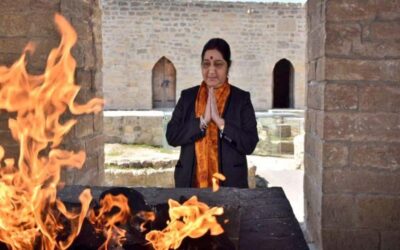
Gobustan, Mud Volcanoes, Fire Temple, & Yanar Dag Tour
Read our review →
Atashgah Fire Temple & Burning Mountain Half-Day Tour
Read our review →Browse the lists this tour appears in